World Cup 2026 Draw Analysis: Data Reveals Shocking Structural Risks and Advantages
The 2026 FIFA World Cup is set to be the largest football tournament in history, and with its new 48-team format, the group stage draw has become more complex and consequential than ever. While the draw is designed to be random, the underlying structure of pots and confederation rules creates a playing field that is anything but level.
To uncover the hidden patterns, we conducted 100 complete, rule-compliant simulations of the World Cup 2026 group draw. The results are fascinating, revealing which top-seeded teams have a major structural advantage, which hosts face a potential nightmare scenario, and how a "Group of Death" is more likely for some than for others. This report provides a quantitative, data-driven look at what the simulations tell us about the road to the final.
Ready to see the possibilities for yourself? You can run your own draw right now.
Grounding the Analysis in Data: A Shift to Elo Ratings
To provide a more accurate and data-grounded analysis of the draw's potential outcomes, we have moved from a simple pot-based ranking to the Elo rating system. Unlike static rankings, Elo ratings are dynamic and reflect a team's current form by adjusting after every international match. A higher Elo rating signifies a stronger team.
This shift allows us to quantify the true difficulty of a group draw beyond the pot it came from. By summing the Elo ratings of a team's opponents, we can calculate a precise Total Opponent Elo score—a direct measure of the challenge they face.
Below, we re-examine the best- and worst-case scenarios for two of Pot 1's most interesting teams—Argentina and Portugal—based on the 100 valid simulations we generated.
Argentina (ARG) - Navigating the Search for Dominance
As a CONMEBOL team, Argentina (Elo: 2113) cannot be drawn against South American rivals, shifting the focus to top-tier European and African threats.
| Outcome | Opponents (Team Codes & Elo) | Total Opponent Elo | Simulation Index |
|---|---|---|---|
| Easiest Group | SUI (1655), RSA (1150), HTI (1050) | 3,855 | Group F, Sim 29 |
| Nightmare Group | AUT (1834), EGY (1500), UKR (1802) | 5,136 | Group L, Sim 88 |
The Path of Least Resistance (Total Elo 3,855)
Argentina's most favorable draw pairs them with opponents from the lower statistical end of their respective pots.
- Switzerland (Pot 2): A tactically sound but lower-rated UEFA side.
- South Africa (Pot 3) & Haiti (Pot 4): A manageable duo, offering a prime opportunity for Lionel Scaloni’s squad to secure maximum points, conserve energy, and build momentum for the knockout stages.
The Central European Gauntlet (Total Elo 5,136)
The nightmare scenario avoids CONMEBOL teams but creates a punishing group by drawing high-ceiling European talent and a strong CAF contender.
- Austria (Pot 2): A physically robust and technically proficient European team (Elo 1834) that presents a significant challenge.
- Ukraine (Pot 4): The lynchpin of this nightmare draw. At 1802 Elo, Ukraine is arguably the most dangerous team in Pot 4, creating a group with two formidable European opponents. This transforms the group into a tight, three-way battle for qualification.
Portugal (POR) - The Looming UEFA Threat
For Portugal (Elo: 1976), the primary challenge lies in navigating a landscape where they could face a top-tier non-UEFA team from Pot 2 and a deceptively strong European side from Pot 4.
| Outcome | Opponents (Team Codes & Elo) | Total Opponent Elo | Simulation Index |
|---|---|---|---|
| Easiest Group | URU (1673), RSA (1150), CUW (1200) | 4,023 | Group C, Sim 61 |
| Nightmare Group | COL (1998), ALG (1550), UKR (1802) | 5,350 | Group C, Sim 54 |
A Manageable Path (Total Elo 4,023)
Portugal's easiest route emerged by drawing a mid-tier Pot 2 team and two of the lowest-rated teams from the remaining pots.
- Uruguay (Pot 2): While historically strong, Uruguay's current Elo (1673) makes them a less daunting opponent than giants like Colombia.
- South Africa (Pot 3) & Curaçao (Pot 4): This pair represents a clear opportunity for six points, giving Portugal a strong platform to top the group.
The Global Gauntlet (Total Elo 5,350)
This scenario represents the most challenging possible group for Portugal, packed with high-performing teams from three different confederations.
- Colombia (Pot 2): As the highest-rated team in Pot 2 (Elo 1998), drawing Colombia immediately creates a clash of titans for group supremacy.
- Ukraine (Pot 4): The 1802-rated Ukraine once again proves to be the ultimate wild card, forcing Portugal into a second high-stakes European matchup.
- Algeria (Pot 3): A solid team (Elo 1550) that ensures there are no easy matches, requiring Cristiano Ronaldo's side to be at their best in every game.
A Deep Dive on the Hosts: Structural Risks for USA, Canada, and Mexico
Host nations get the privilege of being in Pot 1, but our data shows this doesn't guarantee an easy ride. In fact, for one host, it creates a significant structural problem. For more on how hosts have fared historically, see our article on a history of World Cup host performances.
-
Canada (Group B): The 'Italy' Problem Canada faces the highest structural risk of any host. Its position in Pot 1 forces it into frequent pairings with dangerous, non-seeded UEFA teams. The most alarming result from our simulations was the Canada vs. Italy pairing, which occurred in a staggering 21% of all draws. This isn't just bad luck; it's a systemic consequence of the draw mechanics. Canada must prepare for a high probability of facing an elite European opponent right out of the gate.
-
USA (Group D) & Mexico (Group A): Medium-High Risk Both the United States and Mexico also face elevated risk. Their pre-assigned slots and the need to draw a UEFA team from each of the other pots gives them a higher-than-average chance of landing in a "Group of Death." While their situation isn't as precarious as Canada's, their path is far from certain.
Network Clustering: The Forced Matchups
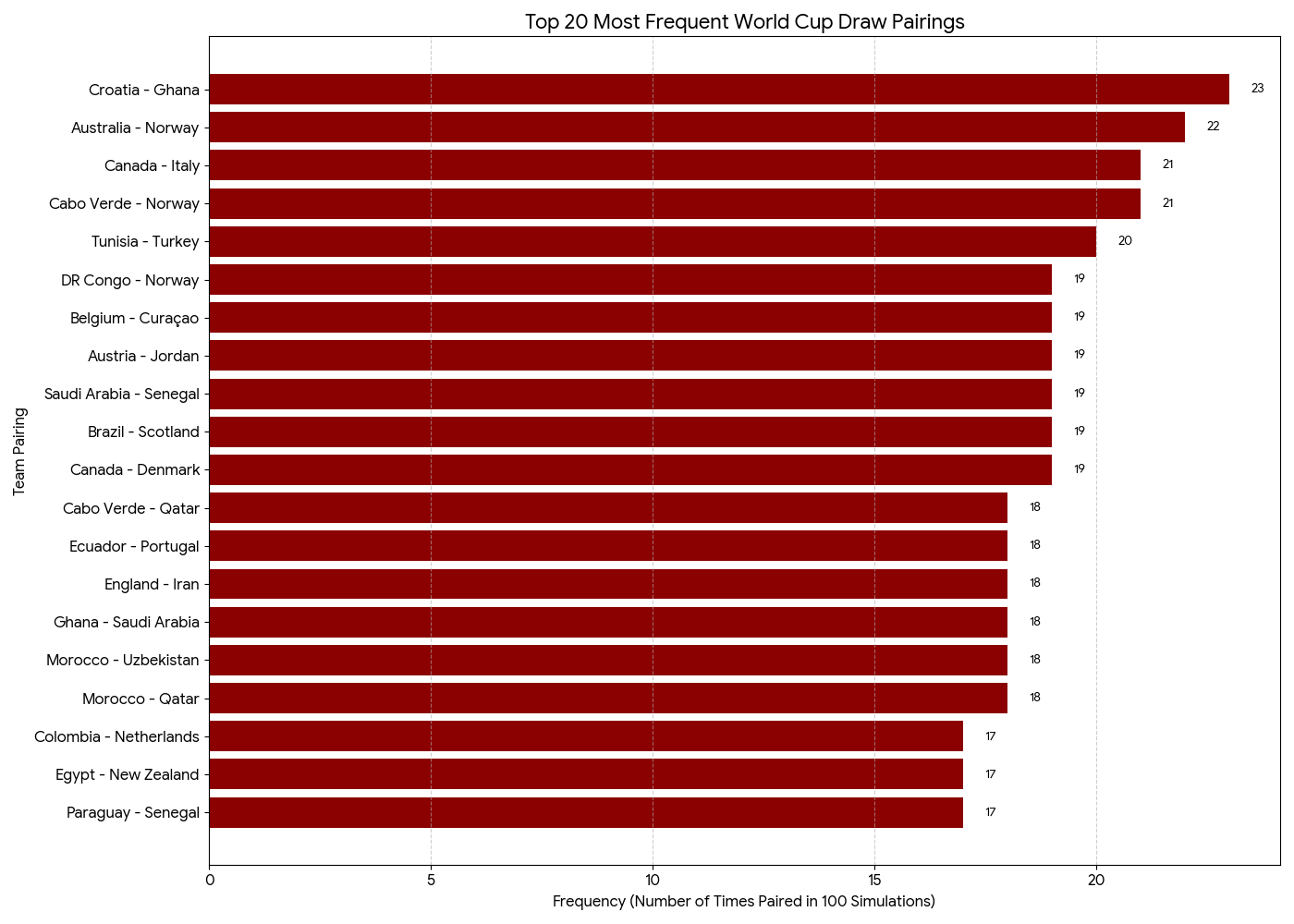
By treating the simulations as a network graph where edge thickness reflects the frequency of teams being drawn together, we identify significant non-random clustering driven by draw rules. This is visualized in the chart below, which shows the 20 most frequent pairings from our 100 simulations.
A. The Most Predictable Pairings (The Clusters)
The top-occurring pairings confirm that confederation constraints create "gravitational pulls" that force specific match-ups:
| Pairing | Frequency (Out of 100) | Constraint Driving Force |
|---|---|---|
| Croatia (UEFA) - Ghana (CAF) | 23 | Pot 2 UEFA teams are forced to draw non-European teams. The available pool leads to frequent CAF pairings. |
| Australia (AFC) - Norway (UEFA) | 22 | Common pairing between mid-tier AFC and lower-tier UEFA teams, determined by group filling order after Pot 1 teams are placed. |
| Canada (CONCACAF) - Italy (UEFA) | 21 | High structural risk for the host nation, as noted above. |
| Cabo Verde (CAF) - Norway (UEFA) | 21 | Two lower-seeded teams frequently placed in the same pool due to similar restrictions against Pot 1/2 teams. |
B. The Most Uniform Draw: Spain
In contrast to the strong clusters, Spain exhibits the most uniform opponent distribution (Standard Deviation: 4.46). This indicates that while draw constraints exist, Spain’s position within the UEFA Pot 1 group allows them to face a highly varied field, mitigating the risk of being repeatedly grouped with one specific "boogeyman" team.
Draw Extremes: The Best-Case and Nightmare Scenarios
To illustrate the full range of possibilities, we isolated the absolute easiest (Dream) and hardest (Nightmare) groups that occurred in our 100 simulations for both the luckiest (Argentina) and unluckiest (Portugal) seeds.
| Team | Draw Type | Opponents (Pot 2, Pot 3, Pot 4) | GDS Score |
|---|---|---|---|
| Argentina | Easiest Draw (Dream) | Senegal (P2), Uzbekistan (P3), Ukraine (P4) | 105 |
| Argentina | Nightmare Draw (Worst) | Australia (P2), Algeria (P3), Denmark (P4) | 78 |
| Portugal | Easiest Draw (Dream) | Uruguay (P2), Uzbekistan (P3), Turkey (P4) | 107 |
| Portugal | Nightmare Draw (Worst) | Austria (P2), Egypt (P3), Curaçao (P4) | 78 |
Key Takeaways:
- A Universal Floor: Even with their advantages, both Argentina and Portugal registered the exact same "Nightmare" score of 78. This proves that a "Group of Death" is a possibility for any team, regardless of their structural advantages.
- Luck Still Matters: Portugal, despite being structurally disadvantaged, received the single easiest draw observed across all 100 simulations (GDS 107), showing that the luck of the draw can still override structural weaknesses.
How the Draw Shapes the Road to the Final
The group you are in doesn't just determine your first three matches—it sets your path through the entire knockout stage. The 2026 format, with its Round of 32, creates specific pathways based on group placement.
As seen in the graphic below, teams from certain groups are destined to meet in specific quadrants of the bracket. For example, the winners of Groups A and B are on a collision course, as are the winners of C and D.
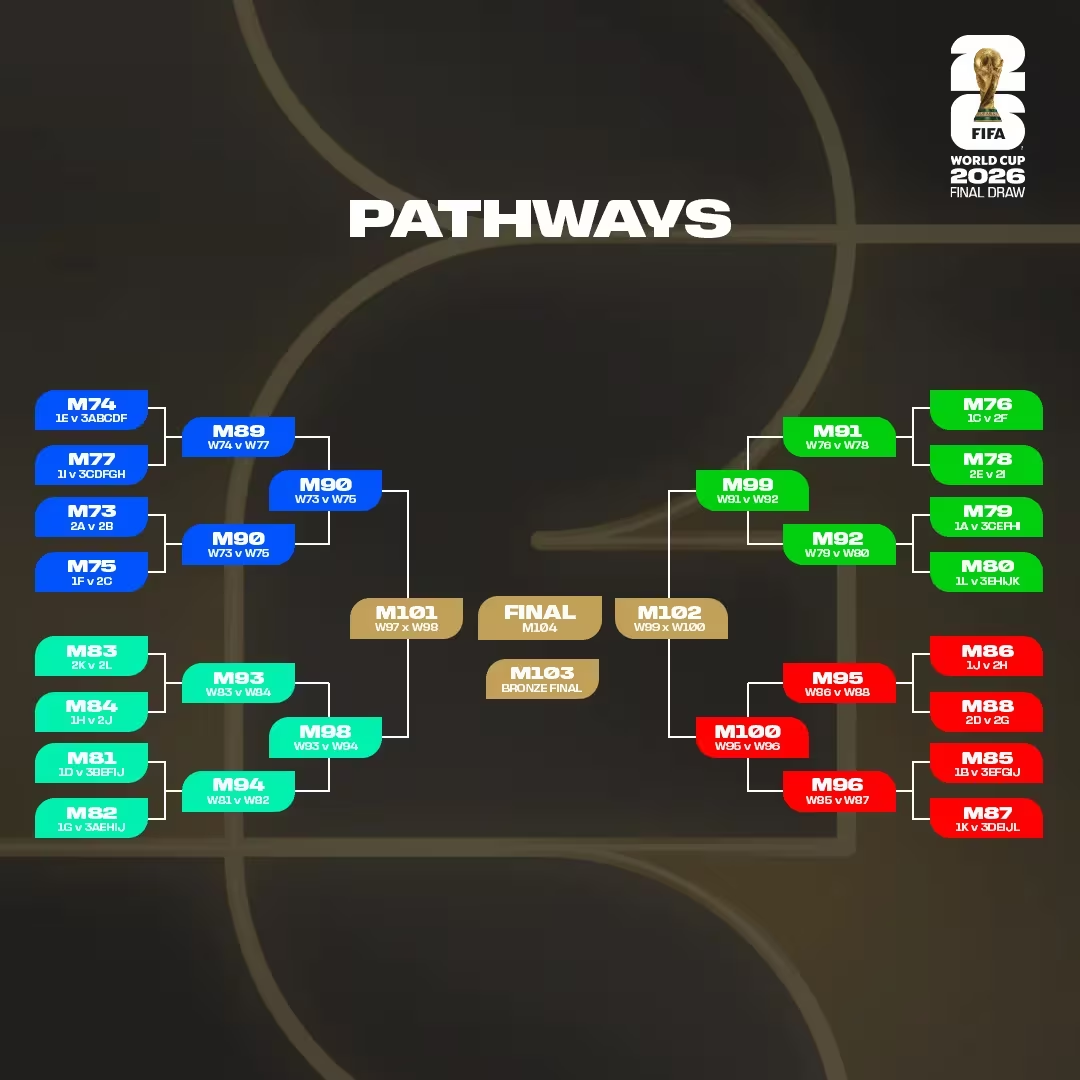
This makes the initial group draw even more critical. Getting an easier group not only increases your chances of advancing but could also mean a much more favorable path to the Final.
FAQ: Your Simulation Questions Answered
Q: Why is Argentina considered "luckier" than Brazil if both are in CONMEBOL? A: The difference is subtle and relates to the specific mix of teams in the other pots. In our 100-simulation model, the combination of potential opponents available to Argentina after all constraints were applied resulted in a slightly lower average GDS.
Q: Does this data mean the draw is "fixed"? A: Absolutely not. The draw is random, but it operates within a heavily constrained system. Our analysis simply reveals the statistical tendencies that emerge from those rules. Think of it like a weighted die—any face can come up, but some are more likely than others.
Q: Where can I find out more about using the simulator? A: We have a complete guide! Check out The Ultimate Guide to the 2026 World Cup Draw Simulator for a step-by-step walkthrough.
Conclusion: It's Not Just Luck, It's Structure
Our 100-simulation analysis proves that the World Cup 2026 draw is a complex system where structure plays as big a role as luck.
- UEFA Pot 1 teams like Portugal face the highest risk of a difficult draw.
- CONMEBOL Pot 1 teams like Argentina hold the greatest structural advantage.
- Host nations, especially Canada, have a statistically high chance of facing elite European competition from the start.
This data provides a crucial layer of insight for fans and analysts alike. It allows us to look past the randomness of a single draw and understand the forces shaping the destiny of all 48 teams on their quest for glory.
What will your draw look like? There's only one way to find out.