World Cup 2026: The "Teams" Column Update That Every Ticket Buyer Needs
The FIFA World Cup 2026 is going to be the biggest sporting event in human history. With 48 teams, 16 host cities, and a staggering 104 matches, the logistical scale is mind-blowing. But for the fans—the people actually trying to book flights to Monterrey or secure a hotel in Seattle—this expansion has introduced a massive new problem: The "Teams TBD" Dilemma.
When you buy a ticket for a knockout stage match today, you aren't buying a ticket for "Argentina vs. Spain." You are buying a ticket for "Winner Match 74 vs. Winner Match 75." You are buying a placeholder. For many fans, this uncertainty is a barrier to entry. "Why should I spend $300 on a Round of 32 ticket in Miami if I don't even know who will be playing?"
Today, we are changing that. We are proud to introduce a major update to our World Cup 2026 Venue Schedule. We have integrated our advanced simulation data directly into the schedule table, adding the two most probable matchups for every single knockout game in the "Teams" column.
Now, when you look at the schedule for Miami, Mexico City, or San Francisco, you won't just see a match number. You'll see the statistical "gravity" of the bracket pulling specific teams toward those venues.
What’s New: The "Teams" Column Upgrade
For months, our users have been using our World Cup Simulator to run 1000s of permutations of the tournament. We’ve published deep dives into The Inevitable Blockbusters and Host Nation Pathways, but we realized that the information was scattered.
Fans needed that data exactly where they made their buying decisions: on the Venue Schedule page.
From Placeholders to Probabilities
The new update replaces generic "Match Number" placeholders with real-world predictions. In the "Teams" column of the schedule table, you will now see:
- The Most Likely Matchup: Based on 1000 simulations, which two teams are most likely to meet in this exact city on this exact date.
- The Runner-Up Matchup: The second most frequent pairing found in our data.
- Real-Time Percentages: We’ve included the percentage chance for each pairing, so you know exactly how stable that prediction is.
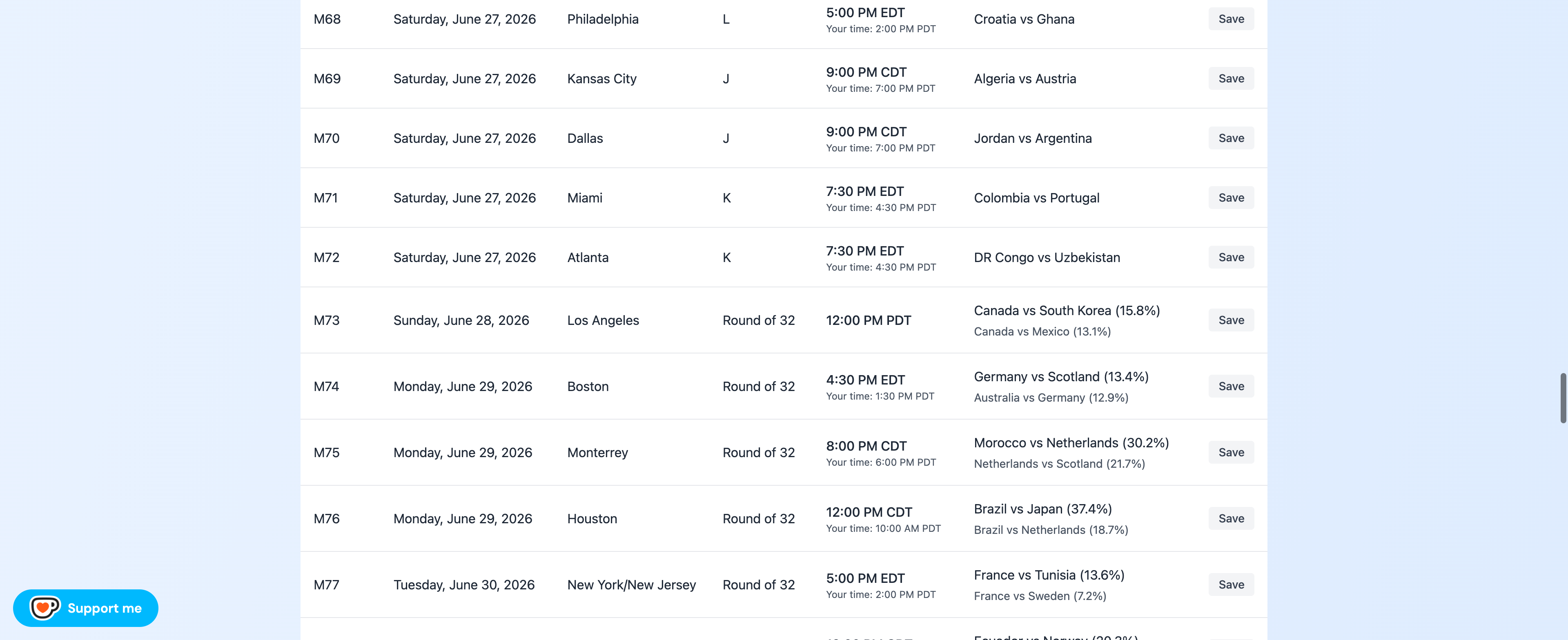 The updated Teams column in action, showing the probability of different knockout matchups for each slot.
This isn't just a guess. This is the result of a massive computational effort using our Elo-based simulation engine. We’ve taken into account every team’s current form, historical performance, the "host nation bump," and the specific mathematical constraints of the 48-team bracket.
Why This Matters: The Science of Bracket "Gravity"
You might be wondering: "It's a 48-team tournament. How can you possibly know who will play in a Round of 32 match months in advance?"
The answer lies in the structure of the draw. FIFA doesn't just pull names out of a hat for the knockout rounds. The bracket is a rigid structure where Winner Group A plays Runner-up Group C (or a third-place team). Because of how teams are seeded into pots, the "powerhouses" like Brazil, France, and Argentina are mathematically funneled toward certain slots.
We call this Statistical Gravity.
Even in a tournament as chaotic as the World Cup, certain outcomes are destined to happen far more often than others. For example, if Argentina wins their group (as they are favored to do in 91% of our simulations) and Uruguay finishes second in theirs, they ARE going to meet in a specific slot. By running 1000 simulations, we see these "gravitational centers" emerge. We’ve moved that intelligence from the background of our supercomputer to the foreground of your ticket-buying experience.
Venue Spotlight: High-Probability Blockbusters
Let’s take a look at how this update changes the way you view specific venues. These are the matches that the data says are "highly likely" to be legendary.
📍 Miami (Match 86 - July 3rd)
- Most Likely: Argentina vs. Uruguay (38.1%)
- Runner-Up: Argentina vs. Spain (20.5%)
If you have tickets for Match 86 in Miami, you should be very excited. Our data shows a nearly 40% chance of a "Derby of the Rio de la Plata" in South Florida. This would be one of the most intense, physical matches of the tournament. Even the second choice—a heavyweight clash between the reigning world champions and Spain—is a monumental encounter.
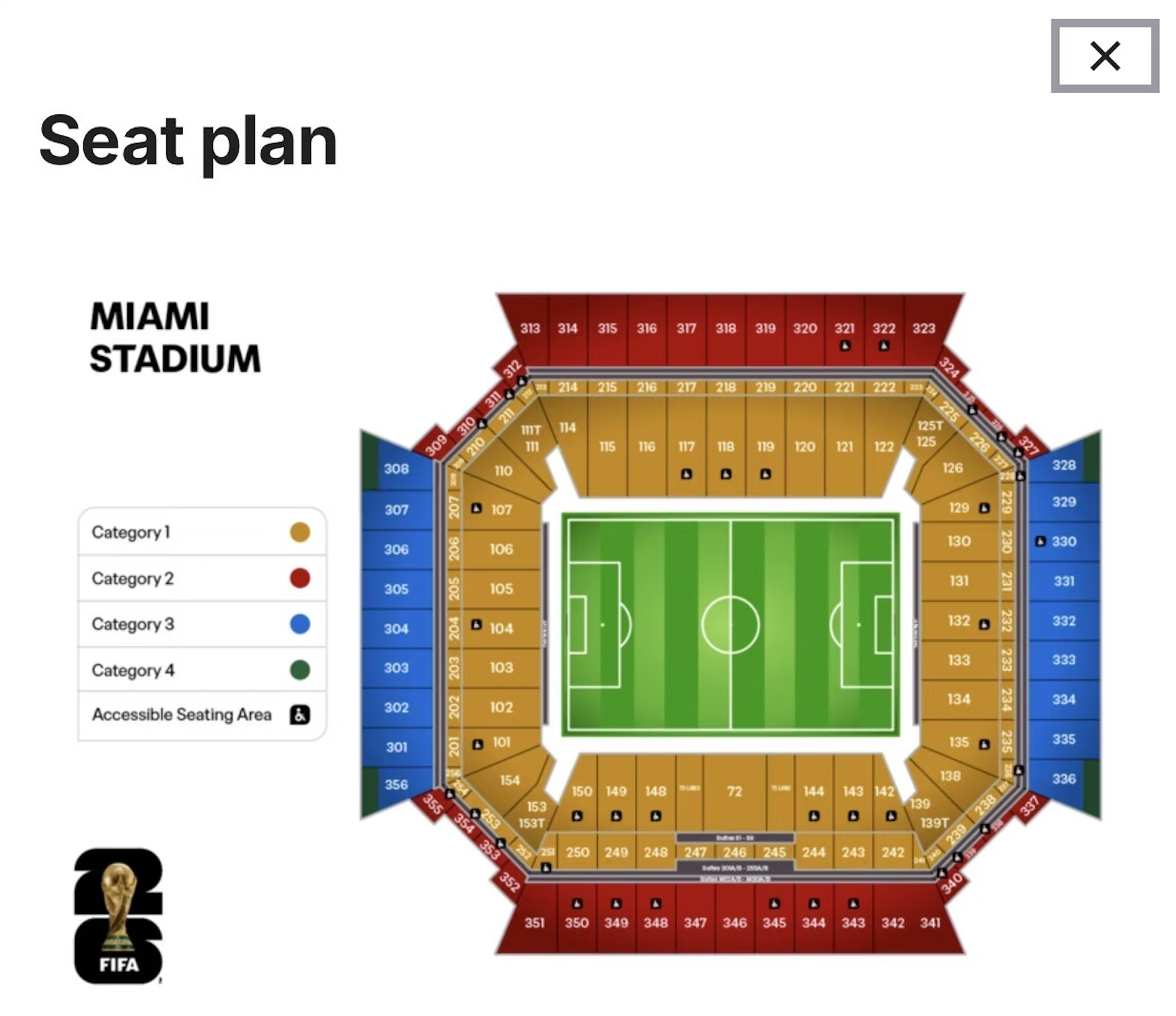 Match 86 in Miami could be the highlight of the Round of 32.
📍 Mexico City (Match 92 - July 5th)
- Most Likely: England vs. Mexico (15.2%)
- Runner-Up: Croatia vs. Mexico (9.9%)
The Estadio Azteca is a cathedral of football. For Mexico City fans, the "Teams" column now reveals a tantalizing possibility: England vs. Mexico. This would be a global spectacle, pitting the Three Lions against El Tri in the most historic stadium in North America.
📍 Seattle (Match 94 - July 6th)
- Most Likely: Belgium vs. USA (25.4%)
- Runner-Up: Iran vs. USA (7.9%)
For American fans, Seattle is looking like the place to be on July 6th. The bracket is heavily skewed toward a USA vs. Belgium rematch of the 2014 classic. This is one of the "stablest" predictions in our entire dataset.
Strategic Guidance: How to Use the Venue Schedule Like a Pro
The Venue Schedule isn’t just a static list; it’s a dynamic roadmap for your World Cup odyssey. To get the most out of this new "Teams" column update, you need to think like a professional scout. Here is our step-by-step guide to mastering the schedule.
Step 1: Filter by Your Geographical Hub
The search bar at the top of the Venue Schedule is your best friend. Instead of scrolling through 104 matches, type your city (e.g., "Houston" or "Toronto"). This will immediately narrow down your options to the 5–8 matches happening in your backyard.
Step 2: Compare "Gravity" Ratings
Look closely at the percentages in the Teams column.
- High Confidence (25%+): These matches are "Brackets Anchors." The path to these slots is so narrow that it’s almost certain one of the listed teams will be there. These are the matches you should build your travel around.
- Low Confidence (Sub-10%): These are "Chaos Slots." These usually involve third-place qualifiers or complex tie-breakers. If you love a good underdog story or a surprising giant-killing, these are the tickets to buy.
Step 3: Analyze the "Runner-Up" Matchup
Don't just look at the #1 prediction. The #2 prediction is equally important for risk management. For example, if a venue shows "Brazil vs. Japan (37%)" and "Brazil vs. Netherlands (18%)", you can be almost 55% certain that you are going to see Brazil in that stadium. If you are a fan of the Seleção, that's a high-value ticket regardless of who the opponent is.
Step 4: Toggle "Show Saved Only" for Your Portfolio
If you’ve already entered the FIFA ticket lottery or bought hospitality packages, mark those matches with the "Save" (star) icon. Then, toggle the "Show Saved Only" view. This transforms the page into a personalized dashboard showing the "Estimated Probability" for your current ticket portfolio. It’s like having a Bloomberg Terminal for World Cup tickets.
Step 5: Export and Sync
Once your plan is finalized, use the "Download Calendar (.ics)" button. This will export your saved matches directly to your phone. Crucially, our export tool includes the probable matchups in the event description, so you’ll always have the latest data at your fingertips.
Expert Tips for Strategic Ticket Buyers
Navigating the ticket market for a 48-team tournament requires a different strategy than previous 32-team iterations. Here are three expert tips based on our latest data.
1. The "Host Advantage" Hedge
If you are aiming for USA, Mexico, or Canada tickets, the Venue Schedule shows that they are heavily favored to win their groups. This places them in very specific slots (Match 81, Match 79, etc.). However, if they stumble and finish second, they will pivot to a completely different part of the bracket. Strategy: Use the simulator to see the "Scenario B" path for the hosts. If you want to be 100% sure you see the USMNT, you might actually need tickets for two different Round of 32 slots.
2. Follow the "Path of Least Resistance"
Some groups (like Group D with Brazil) are so lopsided that the winner is almost a foregone conclusion. This makes the subsequent knockout matches involving Group D very predictable. Strategy: Look for venues that host the winner of these "lopsided" groups. These tickets are often the most stable investments you can make this early in the tournament.
3. The "Deep Run" Multi-City Strategy
The data shows that winner of Match 86 (Miami) likely goes to Atlanta for the Semi-Final. Strategy: If you see a path you love (like the Argentina path), buy tickets in "chains." Buy the Round of 32 in Miami and the Quarter-Final in Kansas City. The math says there’s a high correlation between these two slots.
Deep Dive: How We Built the Simulation Engine
Our update isn’t based on gut feeling or historical anecdotes. It’s purely mathematical. Our simulation engine (which powers the World Cup Simulator) performs three main tasks:
- Elo Rating Integration: We pull real-time Elo ratings for all 48 teams. Elo is a more accurate predictor of strength than official FIFA rankings because it rewards teams for beating difficult opponents rather than just winning friendly matches.
- The 1000-Sim Monte Carlo Method: We run the entire tournament from start to finish 1,000 times. This captures the outliers—the shocks, the penalty shootouts, and the underdog runs—giving us a true probability distribution.
- Bracket Mapping: We map every one of those 1,000 outcomes to the 104 official FIFA match numbers. This allows us to say with certainty: "In 152 out of 1,000 worlds, England played Mexico in the Azteca on July 5th."
FAQ: Everything You Need to Know About the Venue Schedule Update
Q: Why does the "Teams" column show different teams than the bracket page?
A: The bracket page shows a single simulation that you have controlled (manual or random). The Venue Schedule shows the aggregate average of 1,000 simulations. One is your personal prediction; the other is the statistical likelihood.
Q: Will the percentages change in the future?
A: Yes. As we get closer to 2026, we will update the Elo ratings based on qualifying results and friendly matches. If a key player gets injured or a team enters a losing streak, the "Gravity" of the bracket will shift, and the Venue Schedule will update automatically.
Q: What does "(15.6%)" actually mean in a knockout match?
A: It means that in our 1,000 simulated tournaments, those two exact teams met in that exact match number 156 times. While 15% might sound low, in a 48-team tournament with millions of possible combinations, it’s actually a very high confidence interval.
Q: Are third-place teams included in these calculations?
A: Absolutely. The 2026 format includes the 8 best third-place teams. This adds a layer of complexity to the bracket mapping, but our simulator handles the complex "which group gets which slot" matrix perfectly according to official FIFA regulations.
Q: Can I use this for the World Cup travel budget?
A: That is the primary goal! If you know there is a 30% chance of Brazil playing in Houston, you can make an informed decision about whether to book a refundable hotel now vs. waiting for the prices to skyrocket later.
Conclusion: Data is the Ultimate Fan Accessory
The 2026 World Cup's expansion to 48 teams is a gift for the global game, but a challenge for the individual fan. Without data, you are essentially gambling with your vacation time and your wallet.
Our mission with the Venue Schedule update is to bring transparency to the tournament. By moving the probabilistic "Teams" directly into the schedule, we are helping you see through the fog of "TBD" and into the reality of the tournament.
Don't just be a spectator—be a strategic participant. Use the tool, follow the gravity, and prepare yourself for the most exciting World Cup in history.
Explore the Updated Venue Schedule Now!
Planning to attend the final? It's the most unpredictable match in the tournament, but we've narrowed down the top candidates. See our Finalists & Champions Prediction Report for the deep-run breakdown.