How to Buy World Cup 2026 Tickets: The Complete Guide
The race for World Cup 2026 tickets is heating up. With the tournament hosted across the USA, Canada, and Mexico, demand is unprecedented. But if you haven't secured your seat yet, don't panic. There are still opportunities to get into the stadium.
This is the first in our 4-part series on planning your World Cup trip. In this comprehensive guide, we'll cover everything you need to know about buying tickets right now, navigating the resale market, understanding pricing, and why—despite the sticker shock—prices might actually drop as we get closer to the tournament.
Understanding the 4 Phases of World Cup 2026 Ticket Sales
FIFA has structured the World Cup 2026 ticket sales into four distinct phases, each with its own rules and opportunities. Understanding these phases is crucial to maximizing your chances of securing tickets.
Phase 1: The Beta/Presale (Completed)
The first phase was an exclusive early access window for select groups, including VISA cardholders and FIFA insiders. This phase allocated a significant portion of tickets through a random selection draw. If you missed this phase, don't worry—there are still opportunities ahead.
For more details on how the early ticket draw worked, check out our step-by-step guide to entering the FIFA World Cup 2026 Early Ticket Draw.
Phase 2: The First Random Selection Draw (Completed)
The second phase was the first major lottery open to the general public. This random selection draw allocated a large chunk of the remaining inventory. Successful applicants were notified and given specific time windows to complete their purchases.
Learn more about what happened during this phase in our article on World Cup 2026 Ticket Phase 2: The Early Draw.
Phase 3: The "Last" Ticket Draw (CURRENTLY OPEN)
This is where you are now. If you're reading this in early January 2026, the window for the "Last Ticket Draw" is currently OPEN and accepting applications.
This is your final chance to secure tickets at face value through a lottery system before the chaotic First Come First Serve phase begins. The draw operates on a random selection basis, meaning everyone who applies has an equal chance regardless of when they submit their application during the window.
Key Details:
- Application Cost: Free to enter
- Selection Method: Random lottery
- Payment: Only charged if selected
- Ticket Limits: Maximum of 4 tickets per match, up to 10 matches total per household
We strongly recommend submitting an application now before the window closes. It costs nothing to enter, and if selected, you'll have secured your spot for the biggest sporting event in the world.
Phase 4: First Come First Serve (Upcoming)
Once the current lottery phase concludes and winners are notified, FIFA will open the First Come First Serve (FCFS) sales phase. This is the final opportunity to purchase tickets directly from FIFA.
What to Expect:
- Real-time race: Tickets sold on a first-come, first-served basis
- Virtual queues: Expect long wait times and high traffic
- Website crashes: The portal will be under extreme load
- Rapid sell-outs: Popular matches will disappear in minutes
- No guarantees: Unlike the lottery, there's no equal chance—it's purely about speed and luck
For tips on navigating the purchasing process once you're selected, read our detailed account: My World Cup Ticket Draw Experience: A Step-by-Step Guide.
Which Matches Should You Target?
One of the biggest challenges in buying World Cup tickets is deciding which matches to apply for. Now that the group stage draw is complete, you can make more informed decisions about which matches to attend.
Group Stage Matches: The Safe Bet
Group stage matches offer the most predictable experience. With the official group draw now complete, you can see exactly which teams will play in each match and plan accordingly. Check out the qualified teams by pot to understand the tournament structure.
Advantages:
- More tickets available
- Lower prices compared to knockout rounds
- Guaranteed to happen as scheduled
- Great atmosphere regardless of teams
Strategy Tip: Target matches in cities you want to visit. For example, if you're planning to be in the Bay Area, check out our guide on World Cup 2026 Bay Area Matches.
Knockout Rounds: High Risk, High Reward
Knockout stage tickets are more expensive and harder to get, but they offer the most dramatic football.
The Challenge: While we know the group stage matchups, knockout rounds depend on which teams advance. That expensive Round of 16 ticket could feature a dream matchup like Brazil vs. Germany, or it could be two teams you have no connection to.
Want to predict the knockout matchups? Use our World Cup 2026 Simulator to run the tournament based on the actual group draw and see which teams are most likely to meet in each knockout round.
For data-driven predictions on who will win it all, read our analysis: 1,000 Simulations Predict the 2026 World Cup Winner.
Understanding Ticket Categories and Prices
World Cup tickets are divided into four categories, each corresponding to different seating areas in the stadium.
Category Breakdown
- Category 1: Premium seats on the first level, sideline views. Most expensive.
- Category 2: Second or third level, sideline views. Mid-tier pricing.
- Category 3: Second or third level, behind the goals. More affordable.
- Category 4: Budget-friendly seats, available only to residents of host countries (USA, Canada, Mexico).
Price Ranges
Prices vary dramatically based on the match and category:
- Group Stage: $60 - $620
- Round of 32: $125 - $750
- Round of 16: $170 - $980
- Quarter-Finals: $275 - $1,775
- Semi-Finals: $420 - $3,295
- Final: $2,030 - $7,875
For a complete breakdown of prices by city and match, see our comprehensive guide: World Cup 2026 Ticket Prices: The Latest Updates.
Important Note: Prices have increased between sales phases. Our analysis shows significant price jumps from Phase 1 to Phase 2. Read more: World Cup 2026 Ticket Price Shock: Analyzing the Increases.
Where Will You Sit?
Ticket categories don't guarantee specific seats—only a seating area. FIFA assigns exact seats after purchase.
To visualize where each category is located in different stadiums, check out our detailed guide: World Cup 2026 Stadium Seat Maps & Ticket Categories.
The Complete Match Schedule
Planning which matches to attend requires understanding the tournament schedule. The World Cup 2026 will feature 104 matches across 16 host cities over 39 days.
Key Dates:
- Opening Match: June 11, 2026 (Estadio Azteca, Mexico City)
- Group Stage: June 11-27, 2026
- Knockout Rounds: June 28 - July 19, 2026
- Final: July 19, 2026 (MetLife Stadium, New York/New Jersey)
For the complete match-by-match schedule and to see which cities host which rounds, visit our Complete FIFA World Cup 2026 Match Schedule Guide.
Want to explore which stadiums will host the tournament? Read about all 16 venues in our World Cup 2026 Schedule Release Date: Your Guide to the Host Cities & Venues.
Navigating the Resale Market
If you miss out on the official sales, the resale market is your next option. But proceed with extreme caution.
The Official Route: FIFA Resale Platform
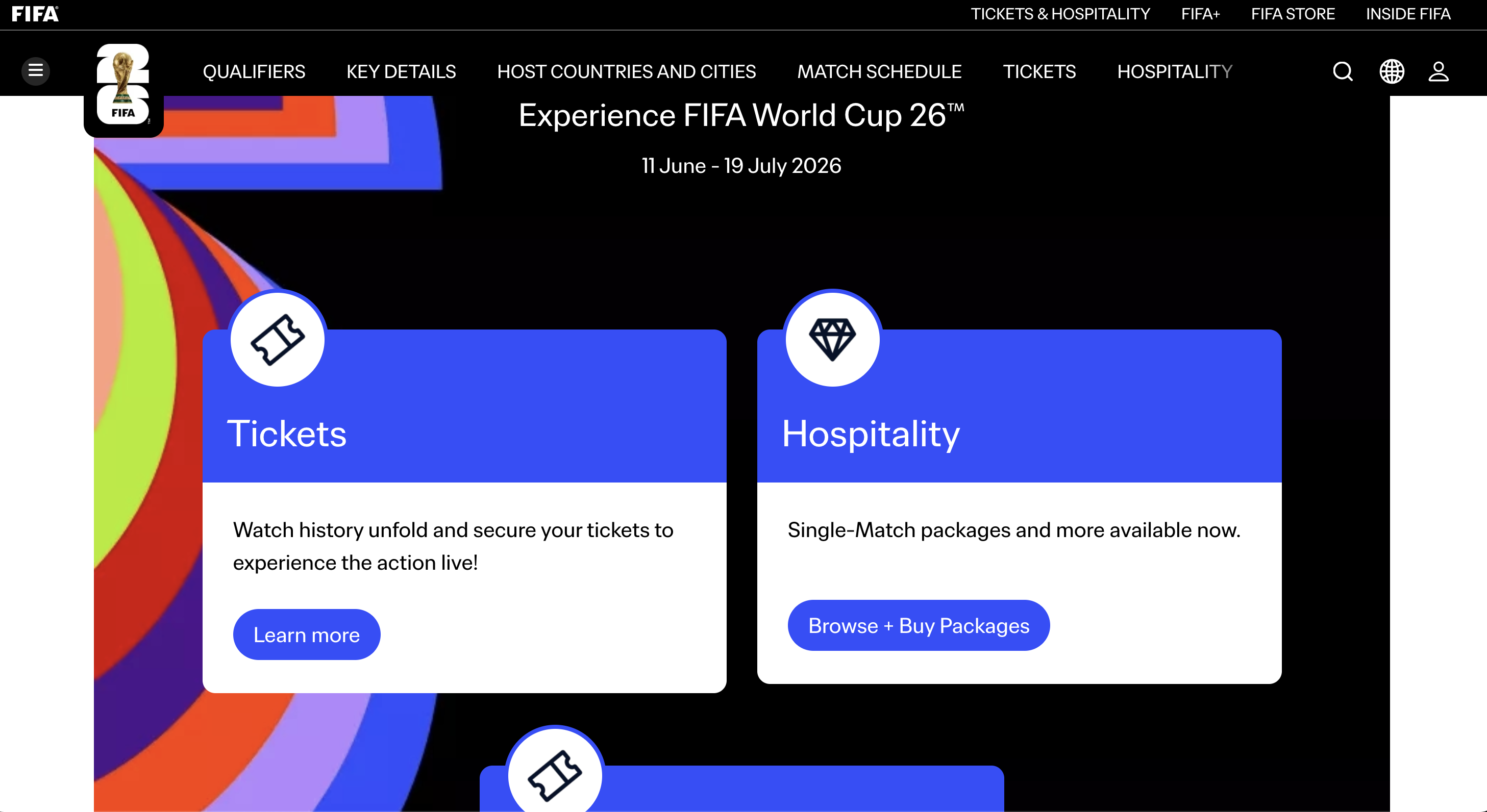
FIFA operates its own official resale platform at fifa.com/tickets. This is the only 100% safe way to buy secondhand tickets.
Why It's Safe:
- Tickets are verified and guaranteed authentic
- Transfer is immediate and official
- Buyer protection through FIFA
- No risk of fraud or fake tickets
- Prices are often closer to face value
How It Works: Fans who can no longer attend can list their tickets on the platform. FIFA facilitates the transfer, ensuring both parties are protected. The platform typically opens closer to the tournament.
The Unofficial Route: Third-Party Platforms
You'll find thousands of tickets listed on platforms like StubHub, Vivid Seats, SeatGeek, and others. However, we generally do not recommend buying from these platforms for World Cup tickets. Here's why:
The Speculative Selling Problem
Many sellers on these platforms don't actually have the tickets in hand yet. They're engaging in speculative selling:
- They list tickets at inflated prices
- If you buy, they then try to acquire the ticket
- They hope to buy it cheaper than what you paid
- They pocket the difference
The Risk: If they can't find a ticket, you get refunded—but you're left without tickets.
The Refund Trap
Here's the nightmare scenario:
- You buy tickets on StubHub for $5,000 in February
- You book non-refundable flights ($1,200) and hotels ($2,000)
- You travel to the match city
- 48 hours before the match, the seller can't deliver
- StubHub refunds your $5,000
- But you're now in a foreign city with no tickets, out $3,200 in travel costs
This happens more often than you think. The platform protects you financially for the ticket cost, but not for all the ancillary expenses you've incurred.
When Third-Party Might Make Sense
There are limited scenarios where third-party platforms might be acceptable:
- You're a local resident and won't lose money on travel if tickets fall through
- You're buying very close to the match date (within 1-2 days) when sellers must have tickets in hand
- You have a backup plan and can afford to lose the ticket cost
- The price premium is reasonable and you're willing to take the risk
Resale Price Reality Check
Current resale prices are astronomical:
- Final Match: ~$16,000 (vs. $7,875 face value)
- Semi-Finals: ~$8,000 (vs. $3,295 face value)
- Quarter-Finals: ~$4,000 (vs. $1,775 face value)
- Group Stage: 2-3x face value
These prices are driven by speculation and scarcity. But will they hold?
Price Prediction: Why Tickets Will Likely Drop
Despite the current sticker shock, there are compelling reasons to believe ticket prices will decrease as we approach the tournament. Here's our analysis:
1. FIFA's Overpricing Strategy
This World Cup's face value prices are already 2-3 times higher than previous tournaments. Even accounting for American wealth and inflation, these prices are unprecedented.
Evidence of Market Resistance:
- Several European Football Associations have formally complained
- Media coverage has highlighted the "pricing out" of average fans
- Social media backlash has been significant
When even the face value is considered too high, the resale market's 2-3x markup becomes unsustainable.
2. The "Soccer in America" Factor
While the Super Bowl commands huge prices, soccer is not the #1 sport in the US. Recent comparable events provide context:
Recent US Soccer Event Pricing:
- Club World Cup 2025: Reasonable, accessible prices
- Inter Miami MLS games (with Messi): $100-500 for premium matches
- Copa America 2024: $75-400 for most matches
- Super Bowl 2026: ~$8,000-12,000 (comparable to current WC Final resale)
The current World Cup resale prices are outliers that don't reflect the true domestic demand for soccer in the US market.
3. Panic Selling by Scalpers
Many people who won tickets in earlier draws bought the maximum allowance (4 tickets per match, up to 10 matches), intending to resell them for profit.
The Scalper's Dilemma:
- They've invested $10,000-50,000 in tickets
- As the tournament approaches, carrying costs increase
- If buyers balk at inflated prices, they're stuck with inventory
- They'll need to offload tickets to recoup costs
- This creates a race to the bottom on price
Timeline: Expect panic selling to accelerate 2-4 weeks before the tournament as scalpers realize they've overestimated demand.
4. More Inventory Incoming
Based on the experience with the Club World Cup and previous tournaments, FIFA often holds back a reserve of tickets that are released very close to match day.
Why FIFA Does This:
- Sponsor allocations that go unused
- Hospitality packages that don't sell
- Reserved tickets for VIPs who don't attend
- Strategic inventory management
When These Release: Typically 1-4 weeks before matches, these cheaper official tickets hit the market and undercut the scalpers, driving overall prices down.
When to Buy on the Resale Market
If you must use the resale market, here's our recommended timeline:
- Now - March 2026: Avoid. Prices are at their peak.
- April - May 2026: Monitor. Prices may start softening.
- Late May - Early June 2026: Sweet spot. Scalpers getting nervous, FIFA releasing more inventory.
- 1-2 weeks before your match: Last chance. Desperate sellers, but risky if you haven't secured tickets yet.
Frequently Asked Questions
How many tickets can I buy?
Per Match: Maximum of 4 tickets per match Total: Up to 10 different matches per household Important: The "per match" limit is actually a "per date" limit. If you buy 4 tickets for a match in Los Angeles on June 24, you cannot buy tickets for a different match on the same date in another city.
What payment methods are accepted?
FIFA accepts major credit cards (Visa, Mastercard). The card you register with doesn't have to be the one you use for final payment.
Can I choose my exact seat?
No. You purchase a ticket category, and FIFA assigns specific seats later. You'll know your exact seat location closer to the tournament.
What if I can't attend after buying tickets?
You can resell your tickets through the official FIFA Resale Platform. Do not attempt to sell through unofficial channels, as this violates FIFA's terms and conditions and could result in ticket cancellation.
Are tickets transferable?
Yes, but only through the official FIFA ticketing system. You can transfer tickets to friends or family members through your FIFA account.
What happens if a match I bought tickets for gets rescheduled?
FIFA will honor your tickets for the rescheduled date or offer a refund. This is extremely rare but has happened in past tournaments due to extreme weather or other unforeseen circumstances.
Can I buy tickets if I'm not a resident of the host countries?
Yes! While Category 4 tickets are reserved for residents of the USA, Canada, and Mexico, Categories 1-3 are available to fans worldwide.
How do I know if a ticket is legitimate?
Only buy from:
- The official FIFA ticketing portal
- The official FIFA Resale Platform
- Authorized FIFA hospitality partners
Any other source carries significant risk of fraud.
Planning Your World Cup Trip
Securing tickets is just the first step. You'll also need to plan:
- Visas: Coming in Part 2 of our series
- Budget: Coming in Part 3 of our series
- Travel Routes: Coming in Part 4 of our series
Explore the Tournament Before You Go
While you're planning your trip, why not explore how the tournament might unfold? Our advanced simulator lets you:
- Run the complete group stage draw
- Simulate knockout rounds
- See potential matchups
- Predict the champion
Want to understand how the draw works? Read our Ultimate Guide to the 2026 World Cup Draw Simulator.
Curious about which teams are most likely to win? Check out our data-driven analysis: 1,000 Simulations Predict the 2026 World Cup Winner.
Your Action Plan
Here's your step-by-step plan to secure World Cup 2026 tickets:
Immediate Actions (This Week)
- ✅ Apply for the Last Ticket Draw (if still open)
- ✅ Research which matches and cities you want to attend
- ✅ Set a realistic budget including tickets, travel, and accommodation
- ✅ Create a FIFA ticketing account if you haven't already
Short-Term (Next 1-2 Months)
- ✅ Monitor your email for lottery results
- ✅ Prepare backup credit cards in case of payment issues
- ✅ Research the First Come First Serve sale timing and strategy
- ✅ Bookmark the official FIFA ticketing portal
Medium-Term (March - May 2026)
- ✅ Watch the official FIFA Resale Platform for legitimate resale tickets
- ✅ Monitor price trends on the resale market
- ✅ Avoid panic buying at inflated prices
- ✅ Plan your travel logistics (flights, hotels, visas)
Final Stretch (June 2026)
- ✅ Last-minute official releases from FIFA
- ✅ Desperate seller discounts on resale platforms
- ✅ Final decision point on whether to buy resale tickets
- ✅ Prepare for your trip!
Final Thoughts
Securing World Cup 2026 tickets requires patience, strategy, and a bit of luck. The current market is inflated, but opportunities remain for smart, patient buyers.
Key Takeaways:
- Apply for the current draw if still open
- Avoid unofficial resale platforms unless absolutely necessary
- Be patient—prices will likely drop
- Monitor the official FIFA Resale Platform
- Have a backup plan
The beautiful game deserves to be experienced live. With the right approach, you can make your World Cup dream a reality without breaking the bank.
Stay tuned for Part 2 of our series, where we'll tackle the complex world of World Cup Visas and entry requirements for the USA, Canada, and Mexico.